
Weekly Scoring Table
| Rank | Leader / Organization | This Week | Overall | Articles |
|---|---|---|---|---|
| 1 | Oregon Department of Agriculture | +1 | +1 | 1 |
| 1 | U.S. Department of Energy | +1 | +1 | 1 |
| 3 | Tina Kotek | 0 | +8 | 1 |
| 4 | Lamb Weston | -1 | -1 | 1 |
| 4 | Trump Administration | -1 | -21 | 2 |
Articles Scored This Week
Feds award $10B to states in second year of rural health grants
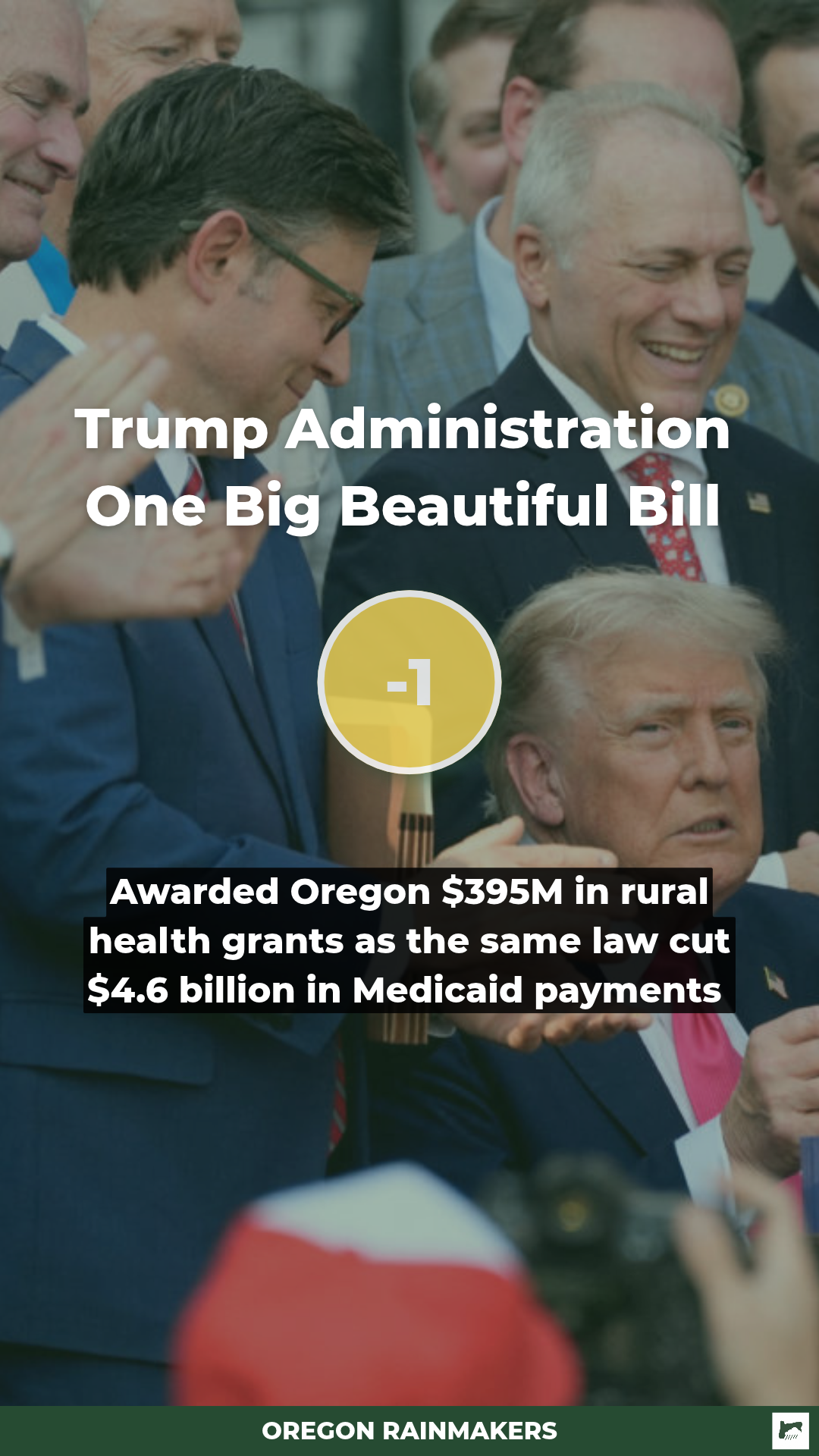
Date: November 10, 2026
Leader / Organization: Trump Administration
Score: -1
Score Headline: Awarded Oregon $395M in rural health grants as the same law projects $4.6 billion in Medicaid cuts.
Score Explanation: The Trump administration awarded Oregon nearly $200 million in new rural healthcare grants, bringing its two-year total to approximately $395 million.
But the same law that created these grants is also projected to reduce Oregon's federal Medicaid funding by $4.6 billion during the 2027–2029 budget period.
The grants will help rural healthcare providers, but they're temporary and don't offset the much larger Medicaid funding reductions.
Lamb Weston latest to settle in NE Oregon groundwater pollution case, will pay $25M
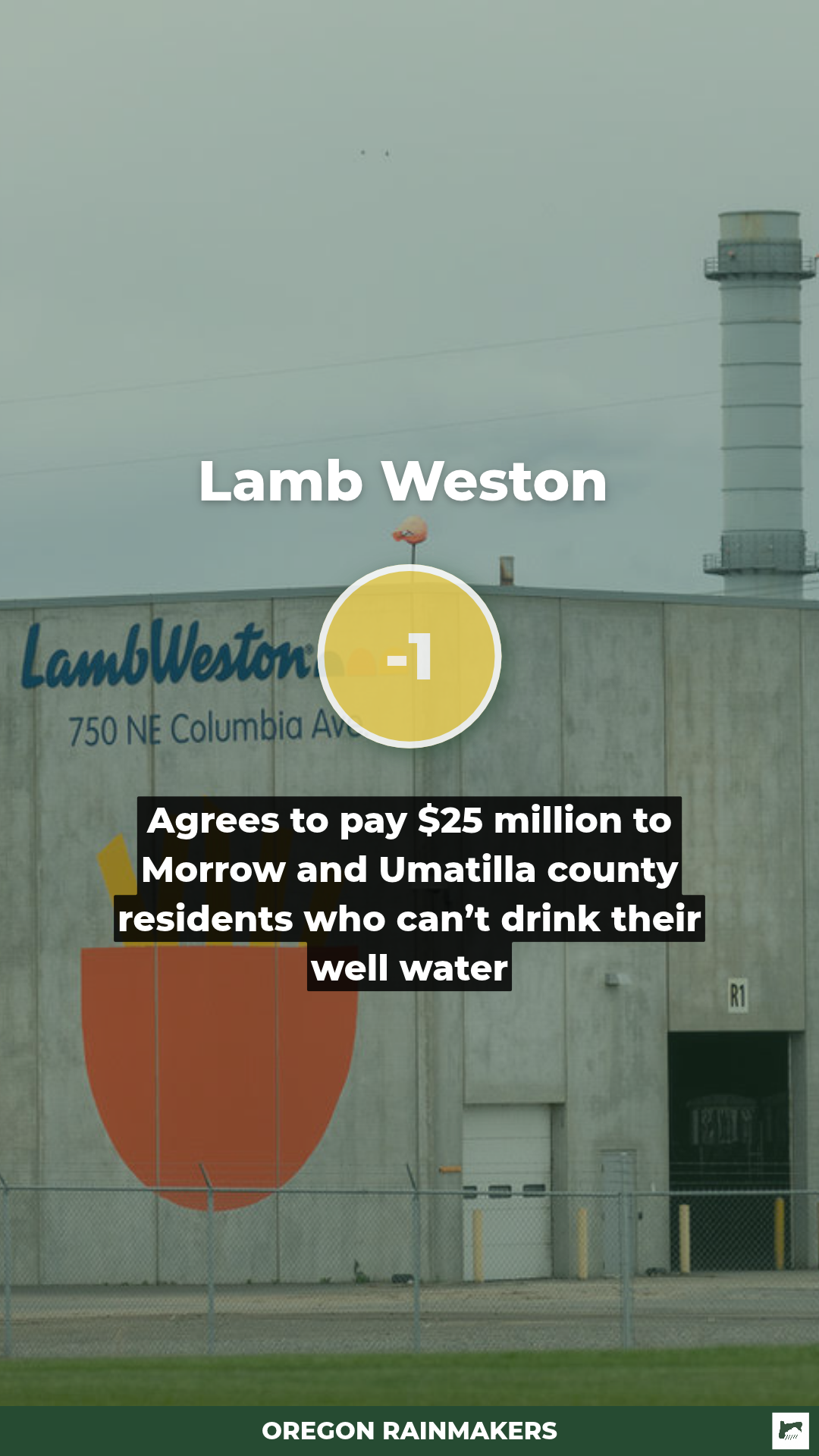
Date: November 12, 2026
Leader / Organization: Lamb Weston
Score: -1
Score Headline: Agrees to $25 million groundwater contamination settlement
Score Explanation: Lamb Weston, one of the nation's largest frozen potato producers, has agreed to pay $25 million to settle a lawsuit over nitrate-contaminated groundwater in Morrow and Umatilla counties, Oregon.
For years, residents have relied on well water containing unsafe nitrate levels. Some households have faced expensive water filtration systems, well replacements, or the need to purchase clean drinking water.
Lamb Weston isn't the only company to settle. Amazon agreed to pay $20.5 million in March 2026, and Madison Ranches settled for $6.2 million in August. Together, these three settlements total $51.7 million.
Industrial wastewater and agricultural runoff have contributed to widespread groundwater contamination in the region. All three companies settled without admitting wrongdoing.
The settlement money will help residents access clean drinking water, but it doesn't undo years of contamination.
Oregon becomes 22nd state to detect bird flu in dairy cattle
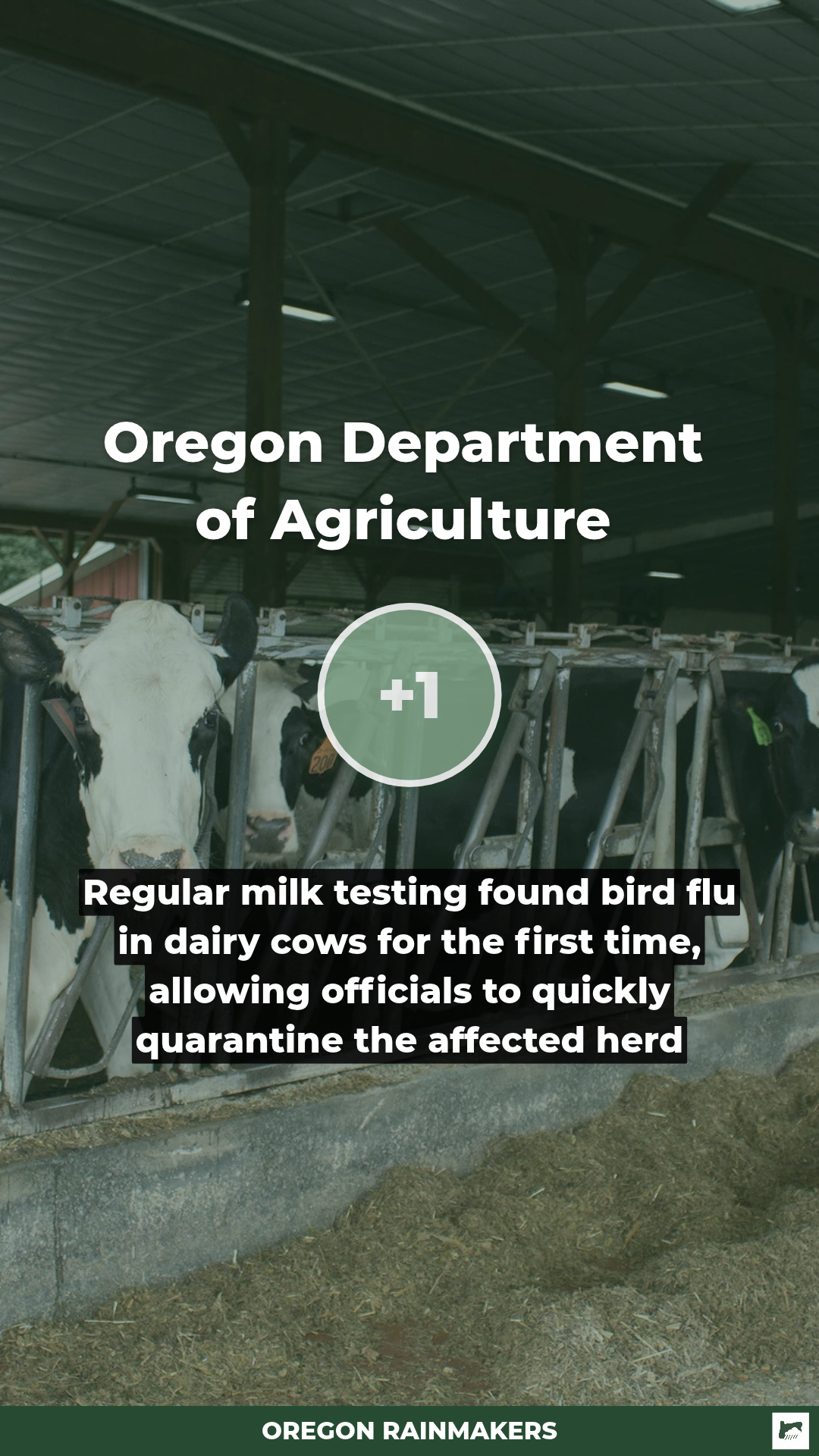
Date: November 12, 2026
Leader / Organization: Oregon Department of Agriculture
Score: +1
Score Headline: Regular milk testing found bird flu in dairy cows for the first time, allowing officials to quickly quarantine the affected herd
Score Explanation: Oregon's milk testing program caught the state's first case of bird flu in dairy cattle, allowing officials to quickly quarantine the affected herd in Morrow County.
The program began in December 2024, after bird flu started spreading among dairy cows across the country earlier that year.
Oregon was one of the first six states to participate in a nationwide milk testing program launched by the USDA. Working with Oregon State University and local dairy producers, the state began regularly testing milk to catch infections early, before they could spread to more farms.
The program paid off in November 2026 when routine testing found the virus. Officials immediately began investigating and took steps to prevent further spread.
The detection also highlights the importance of maintaining strong state-level disease monitoring as federal food safety and public health agencies face staffing and funding cuts.
Pacific Power awarded $50M to squeeze more out of PNW grid
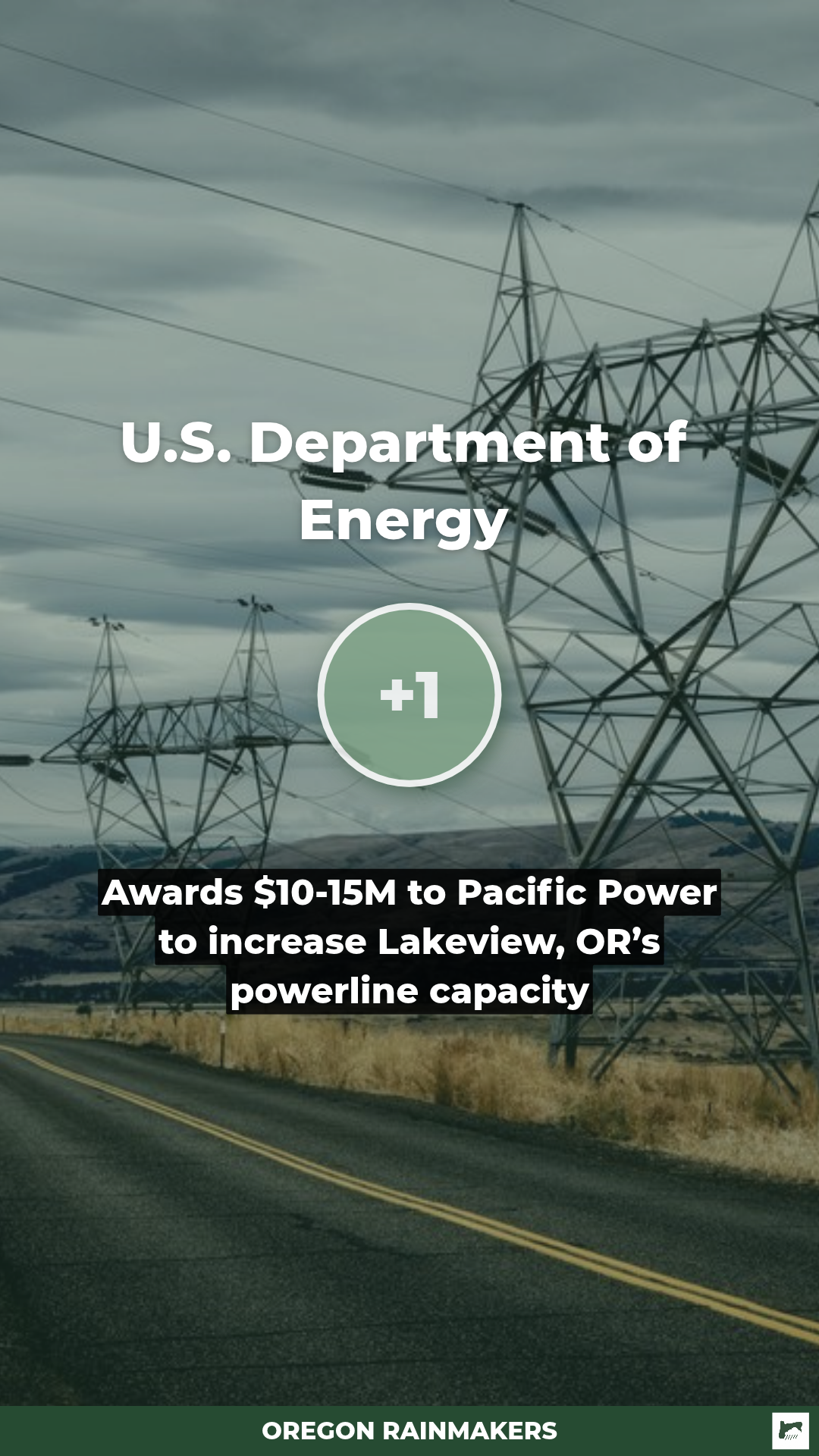
Date: November 12, 2026
Leader / Organization: U.S. Department of Energy
Score: +1
Score Headline: Awards $10-15M to Pacific Power to increase Lakeview, OR’s powerline capacity
Score Explanation: The U.S. Department of Energy has awarded Pacific Power $50 million to upgrade the electrical grid in Oregon and Washington.
The funding will support three projects: one in Lakeview, Oregon, and two in Washington.
In Lakeview, new technology will help existing power lines carry more electricity without having to build entirely new transmission lines. The Washington projects will help control electricity flow and improve the reliability of the grid.
The funding comes from the Bipartisan Infrastructure Law signed by President Joe Biden in 2021. The Trump administration renamed the program Speed to Power and selected the projects for funding in 2026.
Kotek announces start of FastTrack Permitting Program for Oregon projects
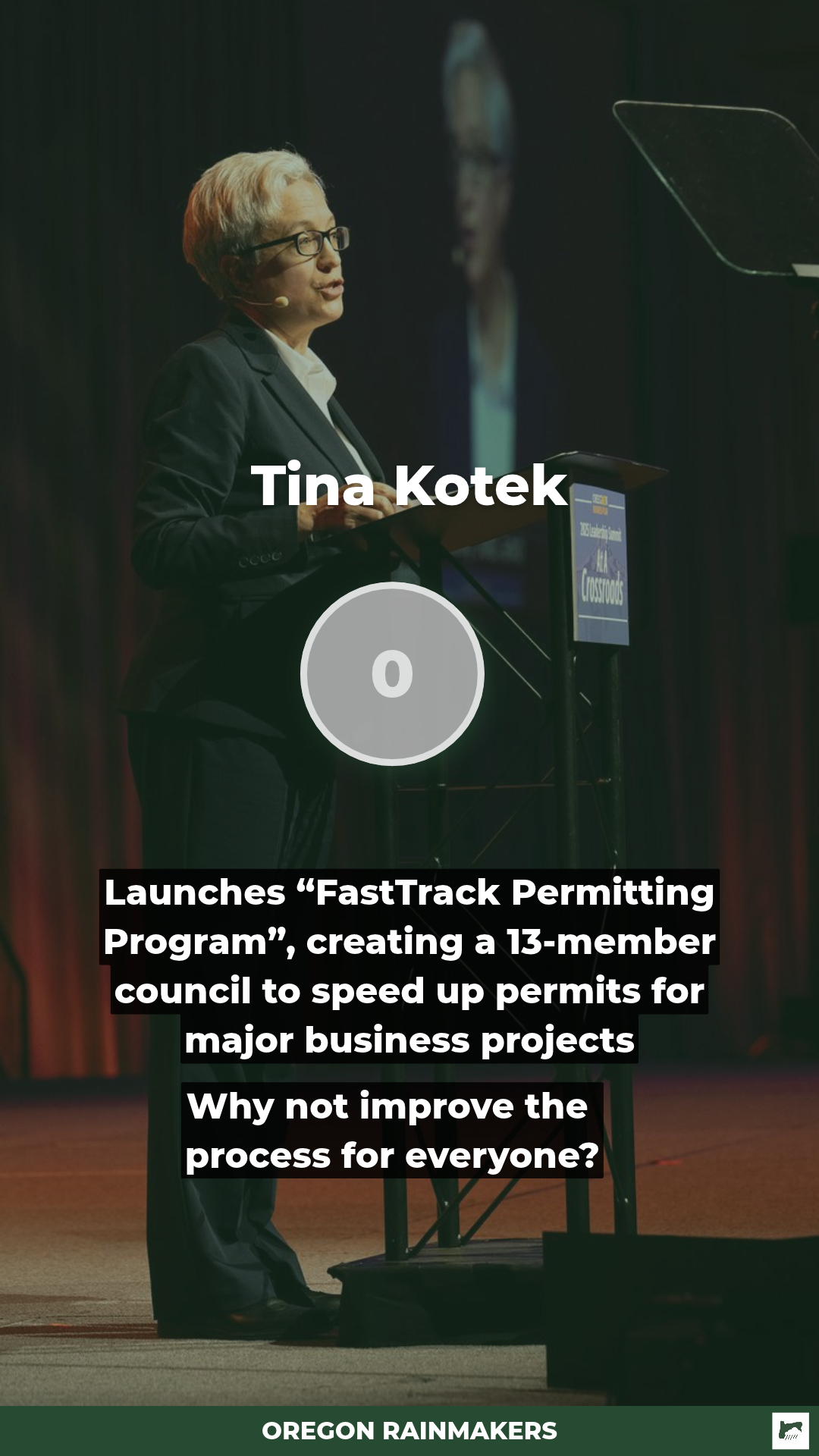
Date: November 13, 2026
Leader / Organization: Tina Kotek
Score: 0
Score Headline: Launches “FastTrack Permitting Program”, creating a 13-member council to speed up permits for major business projects. Why not improve the
process for everyone?
Score Explanation: Governor Tina Kotek has launched Oregon's new FastTrack Permitting Program to speed up government approvals for major business projects.
The program allows up to 15 large projects at a time to receive coordinated reviews from state agencies, with the goal of reducing delays and encouraging businesses to invest and create jobs in Oregon.
To qualify, projects generally must involve investments exceeding $25 million in rural counties, $50 million in other urban areas, or $100 million in the Portland metro area.
The state also created a 13-member Joint Permitting Council to help coordinate the process.
The real test will be whether Oregon uses what it learns to make government faster and more efficient for everyone, not just a handful of major projects.
States have 6 more months to implement Medicaid work requirement, administration says
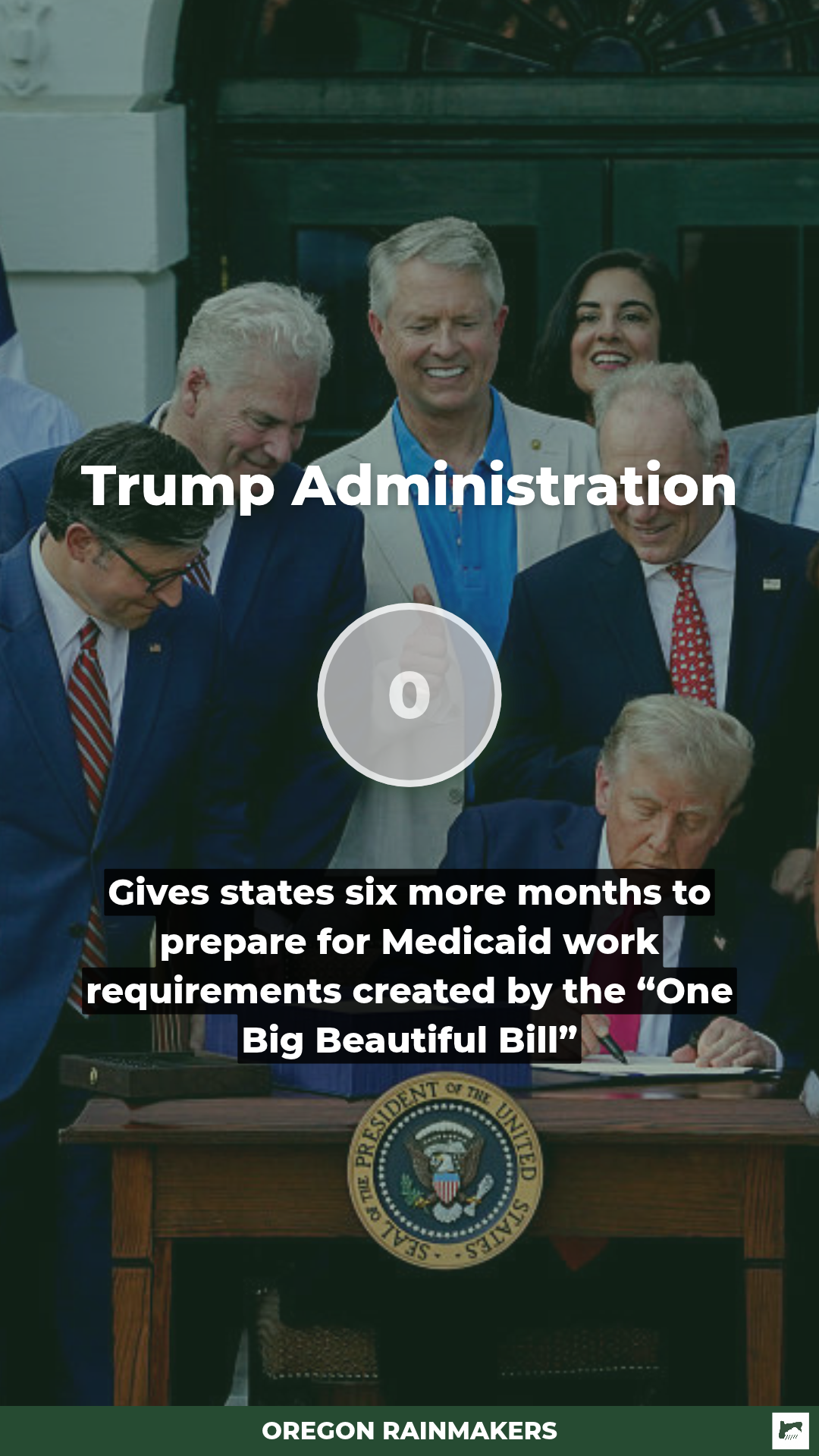
Date: November 13, 2026
Leader / Organization: Trump Administration
Score: 0
Score Headline: Gives states six more months to prepare for Medicaid work requirements created by the “One Big Beautiful Bill”
Score Explanation: The Trump administration is giving states an additional six months to prepare for new Medicaid work requirements.
Currently, most adults in Oregon qualify for Medicaid (the Oregon Health Plan) based on income, household size, and other eligibility rules. There is no general requirement to work, attend school, or volunteer to receive health coverage.
What changes in 2027? Under the law signed by President Trump in 2025, many adults ages 19–64 will have to meet new requirements to keep their Medicaid coverage. They must generally do at least 80 hours per month (about 20 hours per week) of qualifying activities, such as working, volunteering, or job training. Attending school at least half-time can also qualify.
People who don't meet the requirements or cannot provide the necessary documentation could lose their health insurance.
The new requirements are scheduled to begin January 1, 2027. The Trump administration is offering states an optional six-month transition period, through June 30, 2027, to improve their systems and avoid certain penalties as they implement the new rules.
