
Rainmaker Rankings Week of July 19, 2026
Executive Summary
Oregon had several big wins this week.
The Port of Portland earned a +3 for finishing the $2.15 billion PDX project on time and on budget. The Oregon Legislature also earned a +3 after a new law helped free a man whose case used junk science. Alaska Airlines earned a +2 for a new $135 million repair center that should create about 100 high-paying jobs.
The worst score went to South Hills Rehabilitation Center and Volare Health. A woman with dementia left the center and was later found dead, even after she had tried to leave twice before.
The Trump administration also had a bad week. It moved to cut school mental health money and blocked many legal workers from getting or keeping commercial driver’s licenses.
The main lesson this week was simple: good leaders finish projects and solve real problems. Bad leaders create delays, new costs, or unsafe systems.
Weekly Scoring Table
| Rank | Leader / Organization | This Week | Overall | Articles |
|---|---|---|---|---|
| 1 | Port of Portland | +3 | +3 | 1 |
| 1 | Oregon Legislature | +3 | -1 | 1 |
| 3 | Alaska Airlines | +2 | +2 | 1 |
| 3 | Alisha McBride | +2 | +2 | 1 |
| 3 | Janeen Sollman | +2 | +2 | 1 |
| 3 | Malheur County | +2 | +2 | 1 |
| 3 | Tobias Read | +2 | +2 | 2 |
| 3 | Umatilla County | +2 | +2 | 1 |
| 3 | Union County | +2 | +2 | 1 |
| 10 | Oregon Department of Environmental Quality | +1 | +3 | 1 |
| 10 | Dan Rayfield | +1 | +2 | 1 |
| 10 | Animal Legal Defense Fund | +1 | +1 | 1 |
| 10 | Center for Food Safety | +1 | +1 | 1 |
| 10 | Daimler Truck North America | +1 | +1 | 1 |
| 10 | Food & Water Watch | +1 | +1 | 1 |
| 10 | Metro Council | +1 | +1 | 1 |
| 10 | Oregon Board of Forestry | +1 | +1 | 1 |
| 10 | Oregon Department of State Lands | +1 | +1 | 1 |
| 10 | Oregon Health & Science University | +1 | +1 | 1 |
| 10 | Willamette Riverkeeper | +1 | +1 | 1 |
| 10 | Preschool for All | +1 | -1 | 1 |
| 10 | Multnomah County | +1 | -4 | 1 |
| 23 | Candace Avalos | -1 | -1 | 1 |
| 23 | City of Portland | -1 | -1 | 2 |
| 23 | Douglas County Board of Commissioners | -1 | -1 | 1 |
| 26 | Channing Bennett | -2 | -2 | 1 |
| 26 | Lew Frederick | -2 | -2 | 1 |
| 26 | Oregon Department of Education | -2 | -2 | 1 |
| 26 | U.S. Department of Education | -2 | -2 | 1 |
| 26 | Portland Permitting & Development | -2 | -5 | 1 |
| 26 | Portland City Council | -2 | -6 | 2 |
| 32 | South Hills Rehabilitation Center | -3 | -3 | 1 |
| 32 | Volare Health | -3 | -3 | 1 |
| 34 | Trump administration | -4 | -4 | 2 |
Articles Scored This Week
Factory-farm manure sparks lawsuit against Oregon agencies
Date: July 20, 2026
Leader / Organization: Willamette Riverkeeper; Center for Food Safety; Animal Legal Defense Fund; Food & Water Watch
What Happened: Sued the Oregon Department of Agriculture and DEQ, arguing that Oregon’s new factory-farm manure permit does not require enough groundwater and surface-water testing to find pollution.
Issue Areas: Agriculture / Water Quality / Environment / Government Accountability
Rainmaker Recommendation: Require water monitoring at the largest and highest-risk CAFOs, create state-run regional monitoring in polluted agricultural areas, make large operators pay a meaningful share, help smaller farms with installation costs, and charge confirmed polluters for expanded testing and cleanup.
Score: +1
Score Explanation: The groups raised a fair concern that Oregon cannot fully protect its water without testing the water itself. The lawsuit could lead to stronger monitoring and better public information.
Oregon and 14 states sue Trump over cuts to school mental-health funding
Date: July 20, 2026
Leader / Organization: Trump administration; U.S. Department of Education
What Happened: The department moved to end grants ($1 billion) that help schools hire and train mental health workers.
Issue Areas: Education / Mental Health / Student Safety / Government Accountability
Rainmaker Recommendation: Follow the court order and give schools the mental health money Congress approved.
Score: -2
Score Explanation: Cutting this money could leave students with less help at school. The program was already approved by Congress and supported schools across the country.
Leader / Organization: Dan Rayfield
What Happened: Rayfield joined a lawsuit to protect federal money for school mental health workers.
Issue Areas: Education / Mental Health / Student Safety / Government Accountability
Rainmaker Recommendation: Keep fighting to protect the grants and make sure Oregon schools get the money Congress approved.
Score: +1
Score Explanation: Rayfield took a helpful step to protect mental health care for students. The lawsuit has not been decided yet.
Oregon secretary of state slams new Trump election threats
Date: July 20, 2026
Leader / Organization: Tobias Read
What Happened: Read spoke out against threats from the Trump team. The federal government warned Oregon election workers about possible charges and funding cuts. Read said there was no proof of a big voter fraud problem. He also told voters how to make sure their ballots arrive on time.
Issue Areas: Elections / Voting Rights / Government Accountability
Rainmaker Recommendation: Protect Oregon’s vote-by-mail system. Keep private voter information safe. Fix real mistakes in voter records. Give voters clear directions about how and when to return their ballots.
Score: +1
Score Explanation: Read took a good step to protect Oregon elections and help voters. The federal government has not shown that many people are voting illegally in Oregon. But Read mostly spoke out and prepared for problems. He did not win a new court case or make a major change.
After yearlong lull, Portland moves to foreclose on 15 nuisance properties
Date: July 21, 2026
Leader / Organization: City of Portland
What Happened: Moved to restart foreclosure action against 15 properties with serious nuisance violations and about $1.5 million in unpaid city liens.
Issue Areas: Housing / Public Safety / Government Accountability
Rainmaker Recommendation: Act quickly against properties with repeated safety problems and unpaid liens. Give owners a fair chance to fix violations or enter a payment plan, but move to foreclosure when dangerous conditions continue for years.
Score: +1
Score Explanation: Portland took a positive step to address unsafe and abandoned properties that harm neighborhoods. The city is giving owners a chance to fix the problem before foreclosure. However, no foreclosure has been approved yet, and the action comes after more than a year of weak enforcement.
City reactivates task force targeting permitting delays
Date: July 21, 2026
Leader / Organization: City of Portland; Portland Permitting & Development
What Happened: Failed for years to fix a known permitting problem. Earlier reviews and reform efforts did not produce acceptable results, and apartment permits approved in 2026 took a median of 455 business days.
Issue Areas: Housing / Permitting / Economic Development / Government Efficiency
Rainmaker Recommendation: Put one office in charge of the full permit process. Set firm review deadlines, publish permit times for each city bureau, quickly fix conflicting rules, and hold city leaders responsible when projects are delayed. Complete the biggest reforms within one year.
Score: -2
Score Explanation: Portland failed for years to fix a known problem that delays housing, raises building costs, and pushes investment outside the city. The problem involves several city bureaus, but Portland Permitting & Development is responsible for helping lead and coordinate the permitting system.
Oregon considers charging use fees for undersea cables
Date: July 21, 2026
Leader / Organization: Oregon Department of State Lands
What Happened: Proposed higher fees for companies that place internet cables under Oregon’s coastal waters. The money would help pay for state reviews and support public schools. Companies would also need plans for emergencies, cleanup, and old cables.
Issue Areas: Infrastructure / Schools / Government Efficiency / Environment
Rainmaker Recommendation: Charge large companies a fair price to use Oregon’s public seafloor. Use the money to pay for state oversight and public schools. Make companies pay for cleanup and removal of old equipment.
Score: +1
Score Explanation: This is a good plan. Large companies would help pay for the public land and state work they use. The new rules could also help schools and protect Oregon from cleanup costs. But the plan has not been approved yet.
Preschool for All’s new policy will flag low enrollment
Date: July 21, 2026
Leader / Organization: Multnomah County; Preschool for All
What Happened: Created a policy to flag providers with low enrollment. Providers will receive data, support, and time to improve. If seats remain empty, the county may reduce funded seats, reduce payments, deny expansion, or end the contract.
Issue Areas: Child care / Preschool / Taxes / Government Efficiency / Public Trust
Rainmaker Recommendation: Pay providers the true cost of serving enrolled children, but audit how the money is used and reduce funding for seats that stay empty.
Score: +1
Score Explanation: The county took a positive step to make sure Preschool for All money pays for seats that children actually use. This helps address concerns about waste and poor planning.
The Truancy Mutiny
Date: July 21, 2026
Leader / Organization: Alisha McBride; Malheur County; Union County; Umatilla County; Janeen Sollman
What Happened: McBride and other school leaders helped Malheur County create a local attendance law after Oregon ended state truancy tickets. Union and Umatilla counties later passed similar laws. Attendance improved faster in these counties than in the rest of Oregon. Sollman has pushed lawmakers to bring this last-resort tool back statewide.
Issue Areas: Education / Parental Responsibility / Government Accountability
Rainmaker Recommendation: Use this model across Oregon. Schools should first help families solve problems with health, housing, transportation, disability, child care, or bullying. Court-backed attendance plans and possible fines should be used only when families keep refusing to take part. Fines should be dropped when the family follows the plan.
Score: +2
Score Explanation: These leaders took strong action on Oregon’s serious school attendance problem. They built a system that gives families help first but still includes accountability as a last resort. The results so far are strong, with attendance improving faster than the state average. Sollman is also working to make the tool available statewide.
Leader / Organization: Oregon Department of Education; Lew Frederick
What Happened: ODE and Senate Education Committee Chair Lew Frederick opposed bringing back truancy citations. They support helping families with the causes of missed school, but they do not support using court action or possible fines as a last resort.
Issue Areas: Education / Government Accountability
Rainmaker Recommendation: Schools should first help families solve problems with health, housing, transportation, disability, child care, or bullying. Court-backed attendance plans and possible fines should be used only when families keep refusing to take part. Fines should be dropped when the family follows the plan.
Score: -2
Score Explanation: Oregon has one of the nation’s worst school attendance problems. ODE and Frederick are opposing a tool that has been followed by strong attendance gains in Malheur, Union, and Umatilla counties. Their concerns about unfair punishment are valid, but rejecting a carefully limited, last-resort system makes it harder for schools to hold families accountable and help students return to class.
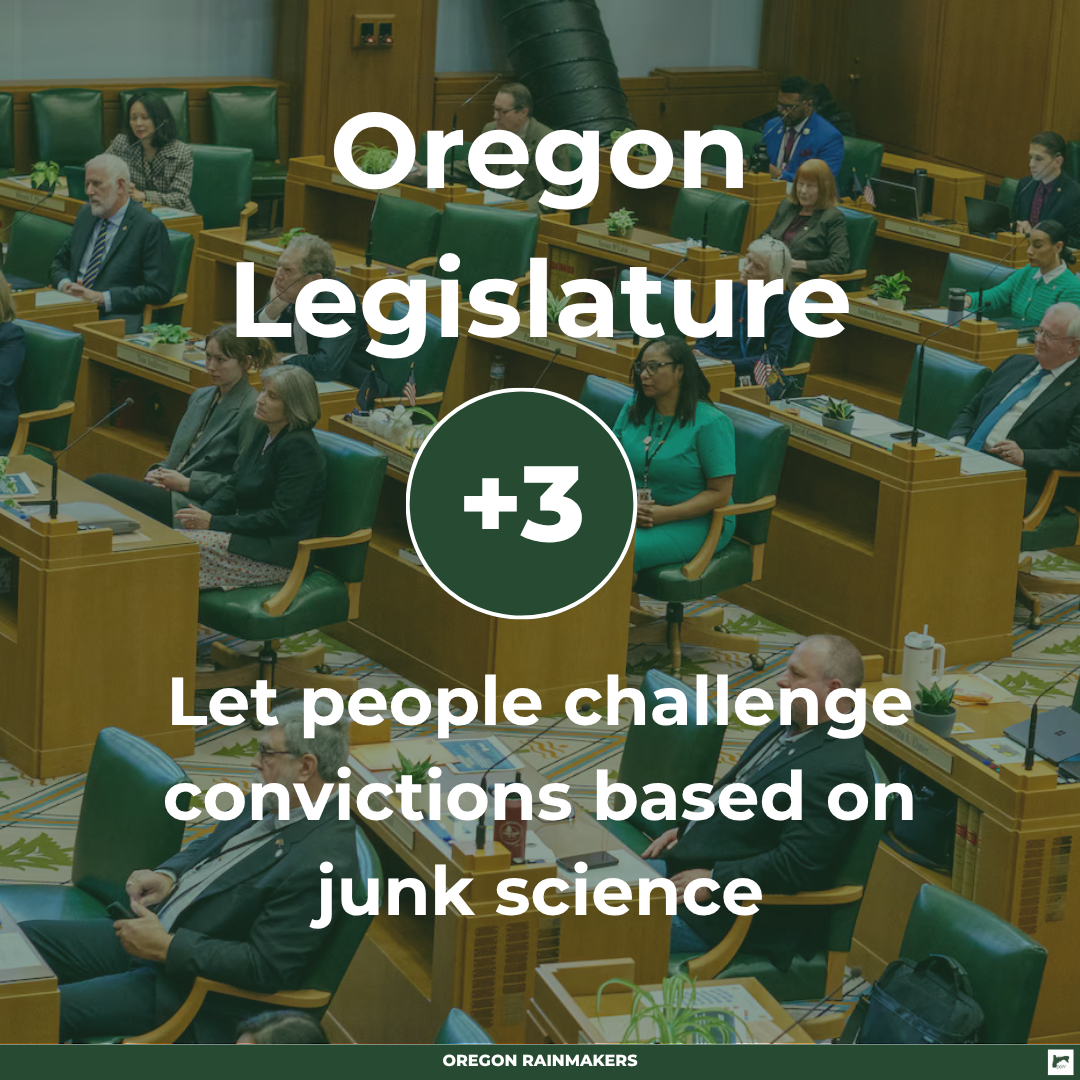
1989 Eugene murder conviction relied on junk science; wrongfully convicted man released
Date: July 22, 2026
Leader / Organization: Oregon Legislature
What Happened: Passed a law that lets people challenge convictions based on junk science. The law covers bite marks, hair comparisons, and bullet comparisons. Robert Wallace Lyons became the first person freed under the law after spending 37 years in prison.
Issue Areas: Criminal justice / public safety / courts / government accountability / civil rights
Rainmaker Recommendation: Review other Oregon convictions that used junk science. Help courts act quickly when old evidence is no longer trusted. Make sure victims and their families receive clear updates when a case is reopened.
Score: +3
Score Explanation: Oregon lawmakers fixed a serious problem in the justice system. The new law helped free a man whose conviction relied heavily on bite-mark evidence that is no longer trusted. He lost 37 years of his life in prison. The law may also help other people who were convicted using bad science.
Audit finds old tech, maintenance backlogs, staffing shortages plague Oregon prisons
Date: July 22, 2026
Leader / Organization: Tobias Read
What Happened: Released an audit that found major problems in Oregon’s prisons. The audit found old buildings, too few workers, and a computer system from 1989. It also found almost $861 million in repairs that have not been done.
Issue Areas: Government accountability / public safety / prisons / state budget / staffing / technology
Rainmaker Recommendation: Legislature should fund the repairs. Keep checking whether the Department of Corrections fixes the problems found in the audit. Give lawmakers and the public clear updates on prison repairs, staffing, computer systems, costs, and deadlines.
Score: +1
Score Explanation: Tobias Read’s audit showed serious problems in Oregon’s prison system and gave the state clear steps to fix them. The audit helps the public and lawmakers understand what is wrong and what needs to be done.
Council passes ordinance to preserve 30 jobs and reverse some public-safety cuts

Date: July 22, 2026
Leader / Organization: Portland City Council
What Happened: The City Council passed a budget that removed about 140 city positions. Five weeks later, it used about $10 million to bring back 30 positions and restore some police and fire services. About 110 position cuts remained.
Issue Areas: City budget / government efficiency / public safety / jobs / police accountability / public trust
Rainmaker Recommendation: Make clear choices before passing the city budget. Protect the most important jobs and services during the normal budget process. Do not pass major cuts and then use reserve money to undo them only weeks later.
Score: -1
Score Explanation: Bringing back 30 jobs and some police and fire services was helpful. But the council had just approved these cuts five weeks earlier. It then spent weeks fighting over the same choices and used reserve money to change the new budget. This was a poor process and made the city’s budget harder to trust.
Eugene rehab center barred from accepting new residents after patient’s death
Date: July 22, 2026
Leader / Organization: South Hills Rehabilitation Center; Volare Health
What Happened: A resident with dementia left the facility and was found dead three days later. She had tried to leave twice in the two days before she went missing. The state said the facility did not take the steps needed to keep her safe. Oregon then stopped the facility from taking new residents until it fixes its problems and trains its staff.
Issue Areas: Senior care / health care / public safety / government oversight / staffing / accountability
Rainmaker Recommendation: Keep residents safe by having enough trained staff, updating safety plans after warning signs, and quickly fixing known care problems. The state should closely watch the facility and not allow new residents until it proves that people are safe.
Score: -3
Score Explanation: The facility failed to protect a woman with dementia even after she tried to leave twice. She later left again and was found dead. The facility also had many past safety and care problems. This was a major failure to protect a person who depended on the facility for care.
Jobs, routes and a $135 million investment: Inside Alaska’s PDX growth
Date: July 22, 2026
Leader / Organization: Alaska Airlines
What Happened: Began building a $135 million aircraft maintenance hangar at Portland International Airport. The new site is expected to create about 100 permanent jobs paying more than $120,000 a year. Alaska has also added more flights and routes from Portland.
Issue Areas: Economic Development / Transportation / Infrastructure
Rainmaker Recommendation: Keep growing Portland as a major airport hub. Add more direct flights, create high-paying local jobs, and make sure public tax breaks lead to the jobs and investment companies promise.
Score: +2
Score Explanation: Alaska Airlines is making a large investment that will create about 100 high-paying jobs and strengthen Portland’s airport. More flights and aircraft work can also support other local businesses. This is a strong action, but it is not large enough to change Oregon’s economy by itself.
Oregon’s western state forests will see more conservation, less clear-cutting under new plan
Date: July 22, 2026
Leader / Organization: Oregon Board of Forestry
What Happened: Approved a new long-term plan for 640,000 acres of western Oregon state forests. The plan protects more land for wildlife, clean water, and carbon storage while still allowing logging. Timber harvests are expected to fall by about 20% over time. The plan covers about 2% of Oregon’s forestland. The federal government manages about 60% and is following a different strategy that calls for more logging, creating a useful comparison over time.
Issue Areas: Forestry / environment / climate policy / timber jobs
Rainmaker Recommendation: Put the plan into action and track the results. Report how it affects wildlife, water, carbon storage, timber jobs, county money, and local schools. Compare it to how the 60% of federally managed forests do. Future forest plans should not take eight years to finish.
Score: +1
Score Explanation: The Board approved a plan that protects more state forestland while still allowing logging. It could help wildlife, water, carbon storage, and long-term legal stability. However, it took about eight years to finish, and the state must watch how it affects timber jobs, county money, and local schools.
PDX cleared for takeoff with $2 billion project complete

Date: July 22, 2026
Leader / Organization: Port of Portland
What Happened: Completed Portland International Airport’s $2.15 billion terminal renovation on time and on budget after 11 years of work. The project kept the airport open, improved passenger flow and earthquake safety, supported 30,000 workers, and awarded $373 million to small businesses. The airport grew 40% while cutting energy use per square foot in half.
Issue Areas: Economic growth / transportation / public infrastructure / energy efficiency / tourism
Rainmaker Recommendation: Economic development projects that are on time and on budget.
Score: +3
Score Explanation: The Port of Portland completed one of Oregon’s largest public projects on time and on budget without closing the airport. The project created jobs, gave hundreds of millions of dollars to small businesses, improved safety and travel, and made the airport more energy efficient. A stronger airport helps Oregon attract visitors, businesses, workers, and investment.
Proposal tightens emissions regulation for commercial properties
Date: July 22, 2026
Leader / Organization: Candace Avalos
What Happened: Proposed a new rule for large commercial and apartment buildings in Portland. Owners would have to report how much energy their buildings use. They would also have to cut carbon pollution by 20% every five years and reach zero by 2050.
Issue Areas: Cost of living / business competitiveness / commercial real estate / climate policy / energy costs / government regulation
Rainmaker Recommendation: Continue collecting and publicly reporting building-energy data, but do not impose mandatory reduction targets until Portland demonstrates it is growing its population and economy.
Score: -1
Score Explanation: Commercial buildings cause a large share of Portland’s carbon pollution, so tracking energy use makes sense. But Portland has fewer people than it did in 2020 and is already struggling to keep businesses and tax money. Adding costly new rules before the city’s population and economy recover could make the problem worse.
Under new proposal, OHSU primate center would change gears
Date: July 22, 2026
Leader / Organization: Oregon Health & Science University
What Happened: Proposed changing the Oregon National Primate Research Center so it uses fewer monkeys and does more research with nonanimal methods. OHSU would reduce breeding, move many monkeys to outside sanctuaries, and keep some monkey research when it believes no good alternative exists.
Issue Areas: Health Care / Medical Research / Animal Welfare / Government Accountability
Rainmaker Recommendation: Set clear goals, move quickly toward better nonanimal science, and require strong proof before monkeys are used.
Score: +1
Score Explanation: OHSU took a positive step toward using fewer monkeys and developing better research methods. The plan does not include firm deadlines, clear population targets, or rules for deciding when monkey research is truly needed.
Daimler move spurs 270,000-square-foot development

Date: July 23, 2026
Leader / Organization: Daimler Truck North America
What Happened: Chose Portland for a new 272,000-square-foot truck-parts warehouse. Daimler plans to move its Reno distribution center to Portland in 2027 to serve growing demand in the Pacific Northwest.
Issue Areas: Economic growth / business investment / jobs / manufacturing / transportation
Rainmaker Recommendation: Economic growth is good.
Score: +1
Score Explanation: Moving a distribution center from Reno to Portland brings new business activity and private investment to Oregon. It is also a good sign that Daimler sees growth in the Pacific Northwest.
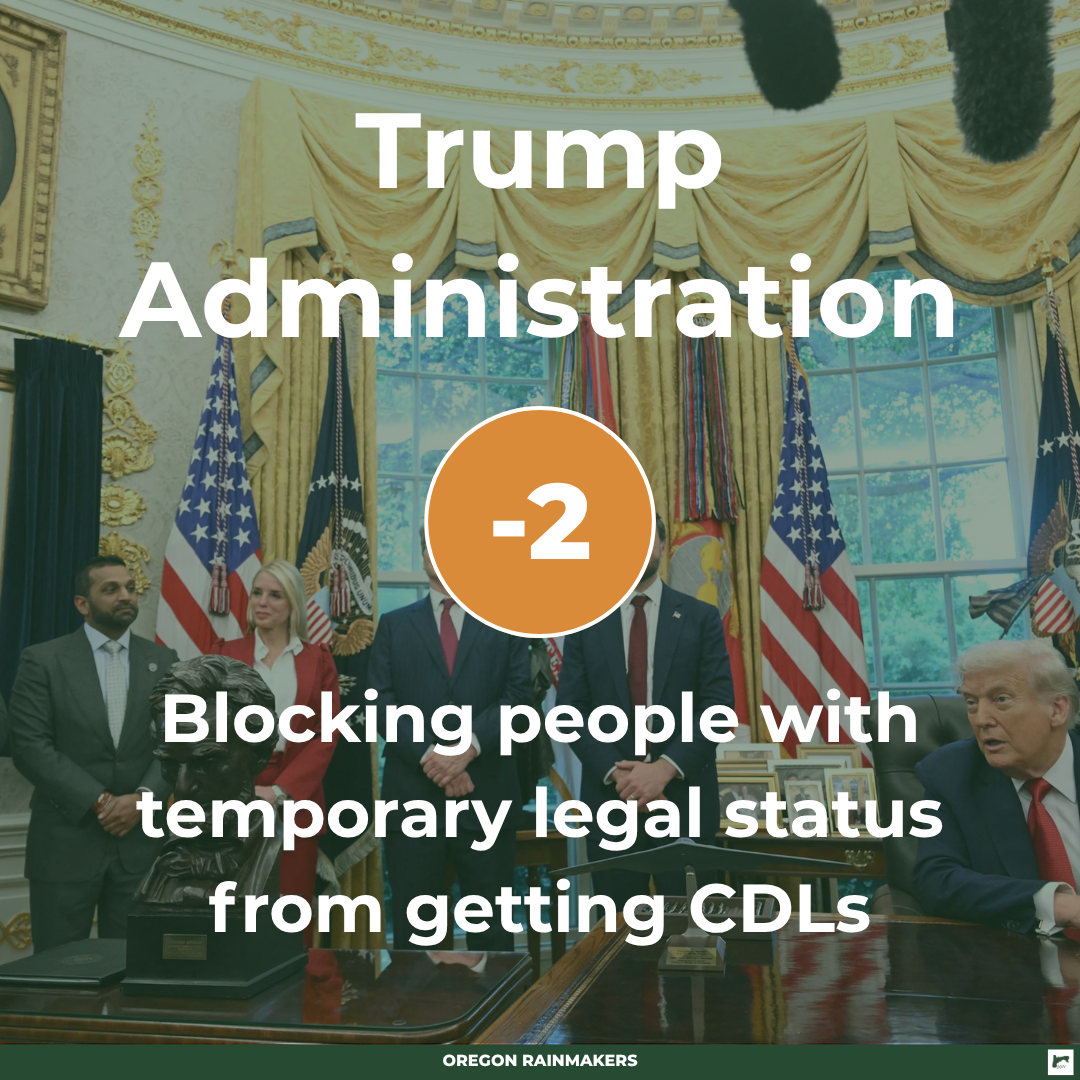
How Trump closed a key career path for Oregon immigrants and refugees
Date: July 23, 2026
Leader / Organization: Trump administration
What Happened: Made a new rule that blocks many people with temporary legal status from getting or renewing commercial driver’s licenses. About 900 people who are legally living and working in Oregon may lose the right to work as truck or bus drivers.
Issue Areas: Jobs / immigration / transportation / public safety
Rainmaker Recommendation: Require every commercial driver to pass the same driving, health, safety, and English tests. Do not block legal workers only because of the type of immigration papers they have. Remove unsafe drivers based on their records and skills.
Score: -2
Score Explanation: Oregon employers still need truck drivers, with about 2,300 job openings reported in 2025. This rule may stop about 900 legal workers from doing a job they are trained to do. Strong safety rules make sense, but workers who pass the same tests should not lose their careers only because of their immigration status.
Metro passes $26 million in parks funding
Date: July 23, 2026
Leader / Organization: Metro Council
What Happened: Approved $26 million for 51 parks and nature projects across the Portland region. The projects will improve parks, trails, streams, farms, wildlife areas, and outdoor spaces. Voters had already approved the bond and tax money used for the grants.
Issue Areas: Parks / outdoor recreation / environment / quality of life / taxes / regional government
Rainmaker Recommendation: Complete the projects on time, publish the final costs and results, and show whether Metro is providing services more effectively than cities and counties could provide them.
Score: +1
Score Explanation: Better parks, trails, and natural areas make the Portland region a better place to live and raise a family. Metro also appears to be using voter-approved money for real projects across the region. However, the projects still need to be completed and tracked. Metro also adds another costly layer of government that could be replaced by cities, counties, and the state.
Oregon wine wins on controversial recycling fees
Date: July 23, 2026
Leader / Organization: Oregon Department of Environmental Quality
What Happened: Moved to lower recycling fees for wineries and other businesses that use glass bottles. The state plans to remove two costs from the glass fee because Oregon already has a strong glass recycling system. The lower fees are expected to begin in July 2027.
Issue Areas: Business costs / recycling / wine industry / government regulation
Rainmaker Recommendation: Make sure future recycling fees match the real cost and benefit of each type of package. Do not charge businesses for services that are already working well.
Score: +1
Score Explanation: DEQ listened to businesses and moved to fix fees that appeared too high. Oregon already recycles much of its glass, so the extra charges brought only a small gain. Lower fees will help wineries during a hard time. However, the state is fixing a problem that should have been caught before the fees began.
Judge’s tirade, gun concerns fuel calls for rare Oregon Supreme Court intervention
Date: July 24, 2026
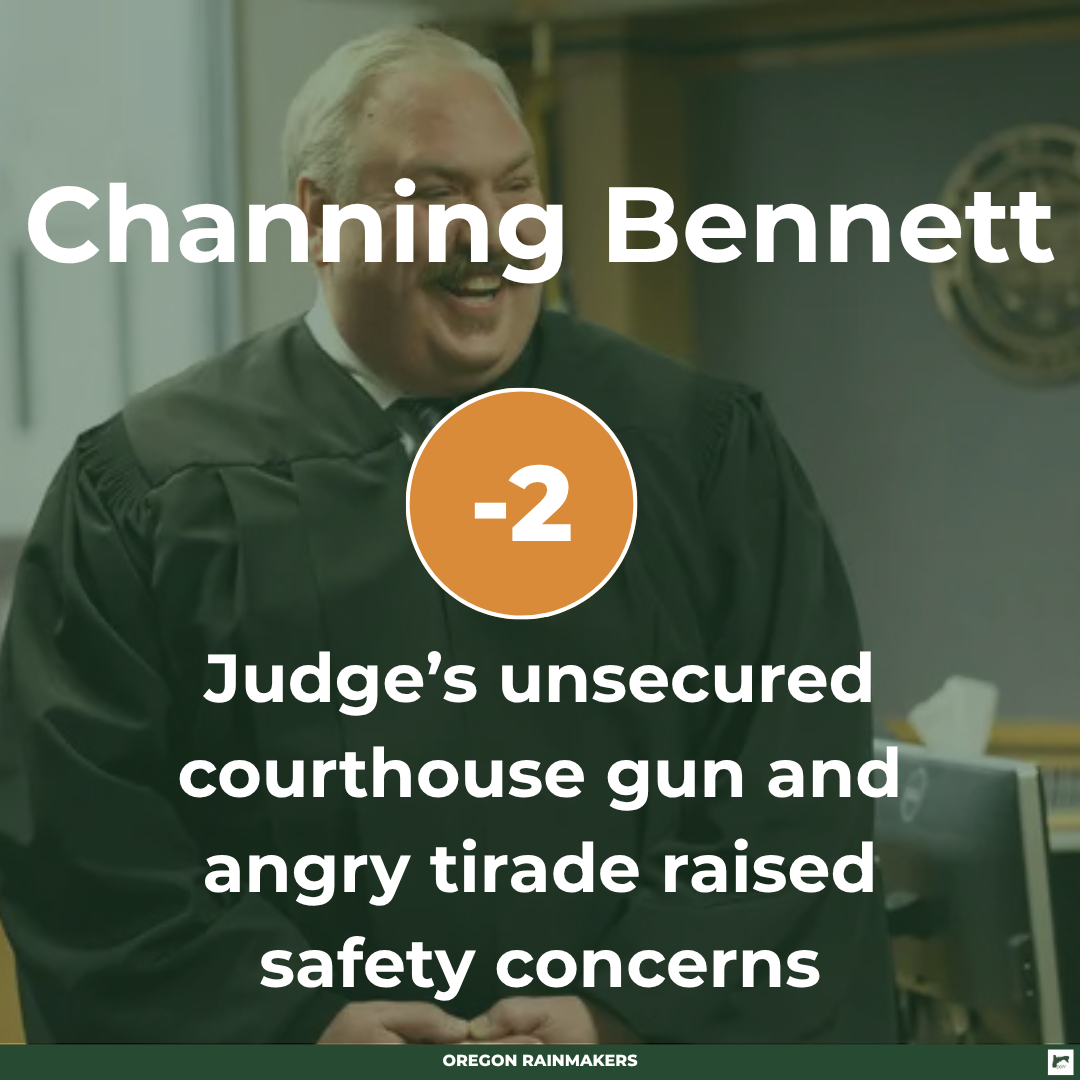
Leader / Organization: Channing Bennett
What Happened: Went on an angry and vulgar tirade about other judges at an after-hours event. Several judges said they no longer felt safe around him. Court officials also found a loaded, unsecured gun under his courthouse desk. Bennett is now on leave while the state reviews his conduct.
Issue Areas: Courts / public safety / government accountability / workplace conduct / public trust
Rainmaker Recommendation: Judges should treat coworkers and the public with respect and follow courthouse safety rules.
Score: -2
Score Explanation: Judges should be fair, calm, and trusted by the public. Bennett’s admitted outburst, the safety fears raised by other judges, and the unsecured gun harmed trust in the court.
Oregon county adopts anti-sanctuary resolution, aligning with Trump immigration agenda despite state law
Date: July 24, 2026
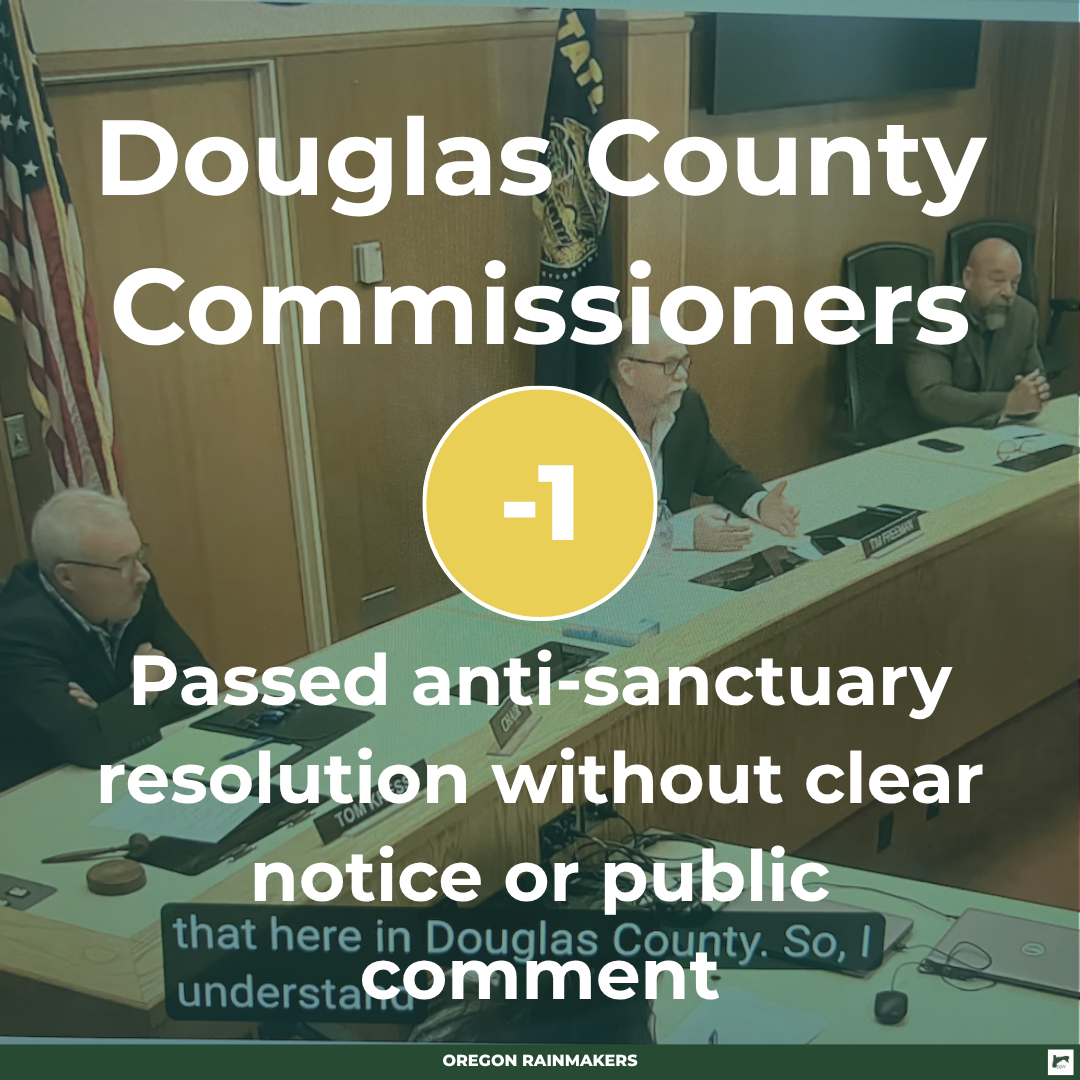
Leader / Organization: Douglas County Board of Commissioners
What Happened: Unanimously passed a resolution against Oregon’s sanctuary law and in support of more work with federal immigration officers. The resolution did not change state law. It was approved without being clearly listed on the meeting agenda or allowing the public to comment first.
Issue Areas: Immigration / public safety / local government / state law / government transparency / civil rights
Rainmaker Recommendation: Clearly list major resolutions on public meeting agendas and allow people to speak before a vote. Follow Oregon law unless it is changed by lawmakers or the courts.
Score: -1
Score Explanation: The resolution did not change the law or create a clear result. But the board passed it without clearly telling the public ahead of time or allowing public comment. That was poor government practice and hurt public trust.
Portland tacks on a brand new fee to residents’ rising utility bills
Date: July 24, 2026
Leader / Organization: Portland City Council
What Happened: Added a new flood safety fee to Portland water and sewer bills. A typical home will pay about $14.40 more each year. The money helps pay for levees, pumps, and other systems that protect Portland from floods. The city had paid this cost from its main budget before moving it to utility bills.
Issue Areas: Cost of living / taxes and fees / government efficiency / public infrastructure
Rainmaker Recommendation: Pay for the flood system through the general fund budget. Stop adding new fees to utility bills without showing what spending will be cut or why current taxes cannot cover the cost.
Score: -1
Score Explanation: Flood protection is important but Portland moved an existing city cost onto utility bills while residents are already paying higher water, sewer, and transportation charges. The fee is small, but adding more charges makes Portland less affordable and avoids harder budget choices.
