
Oregon leaders took action this week on data centers, public defense, teacher training, wildfire costs, endangered-species protections and Southern Oregon University’s financial crisis. Tina Kotek led the weekly rankings with a +2, while the Oregon Public Defense Commission, Ron Wyden, Oregon’s teacher-training programs and SOU also earned positive scores. The Consumer Product Safety Commission received the week’s lowest score over its expanded collection of identifiable emergency-room patient data.
Weekly Scoring Table
| Rank | Leader / Organization | This Week | Overall | Articles |
|---|---|---|---|---|
| 1 | Tina Kotek | +2 | +6 | 1 |
| 2 | Ron Wyden | +1 | +4 | 1 |
| 2 | Oregon Public Defense Commission | +1 | +1 | 1 |
| 2 | Oregon’s 14 Teacher-Training Programs | +1 | +1 | 1 |
| 2 | Southern Oregon University | +1 | +1 | 1 |
| 6 | Oregon Department of Justice | 0 | +3 | 1 |
| 6 | Oregon Legislature | 0 | +3 | 1 |
| 8 | U.S. Consumer Product Safety Commission | -3 | -3 | 1 |
Articles Scored This Week
Democrats demand Trump administration halt collection of patients’ ER records

Date: September 8, 2026
Leader / Organization: Ron Wyden
Score: +1
Score Headline: Calls for halt to expanded collection of ER patient records
Leader / Organization: U.S. Consumer Product Safety Commission
Score: -3
Score Headline: Pressures hospitals to turn over identifiable ER patient records
Score Explanation: Sen. Ron Wyden joined six other senators and five House members in calling on the Consumer Product Safety Commission to immediately suspend a new program seeking personally identifiable medical records from emergency-room patients. The program seeks information including names, birthdates, addresses and diagnoses, even for injuries and conditions that have little to do with consumer products. Lawmakers questioned whether the program is legal or necessary.
The CPSC began quietly pressuring hospitals in 2026 to send these records to its private contractor, KONZA Health. Hospital officials were told participation was “mandatory”, and CPSC officials said hospitals could face penalties if they refused. That is a major expansion from the agency’s traditional system, which generally collected de-identified information about consumer-product injuries and requested identifiable information in fewer than 1% of cases.
The timing also raises broader privacy concerns. The Trump administration has separately given ICE access to Medicaid data that can include personal information such as home addresses, and other federal agencies have sought large collections of identifiable health records.
Gov. Kotek pauses data centers on state land. Capitol demonstrators want her to go further.
Date: September 8, 2026
Leader / Organization: Tina Kotek
Score: +2
Score Headline: Pauses new data centers on state-owned land
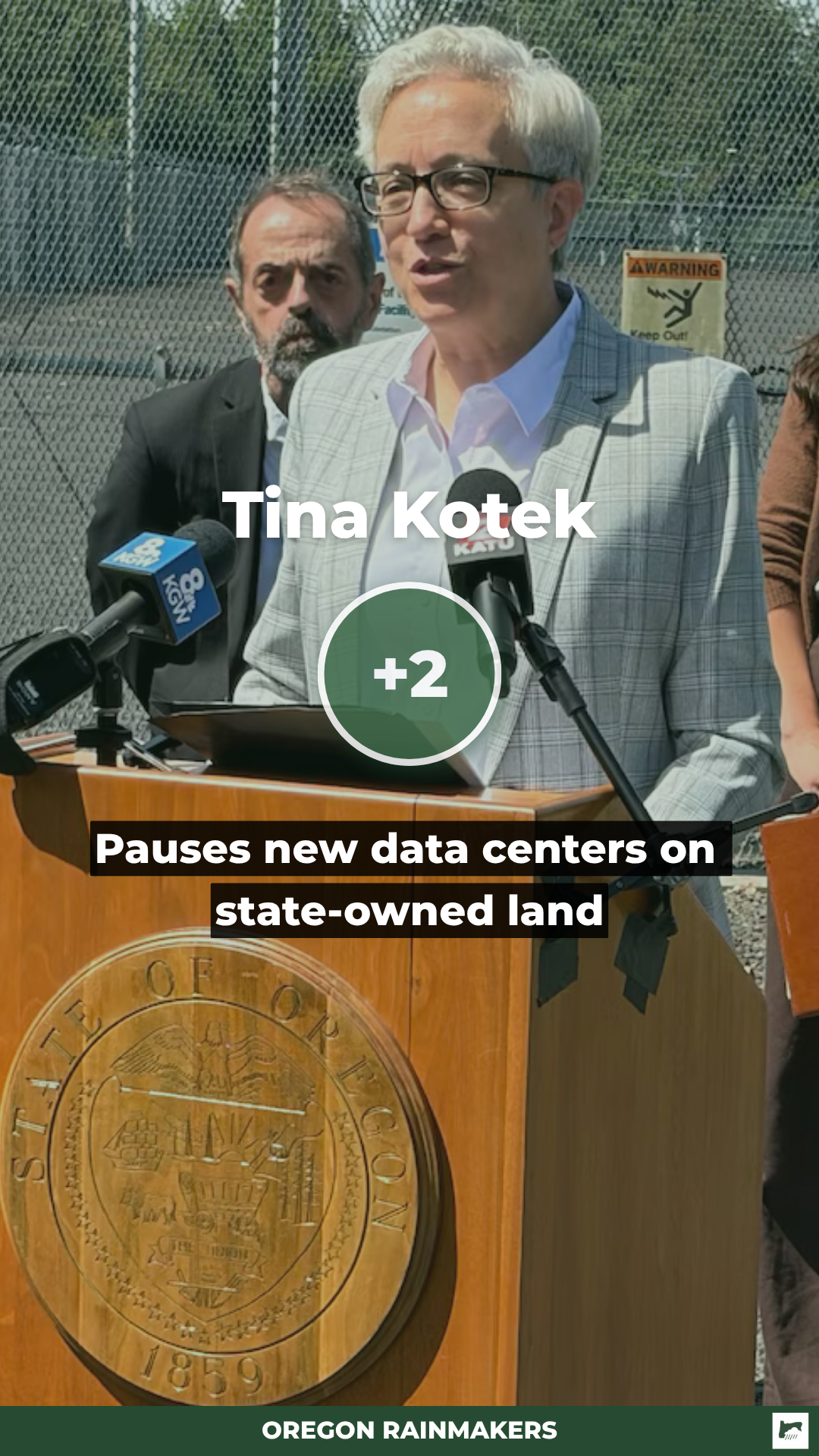
Score Explanation: Gov. Tina Kotek told Oregon agencies to pause new data-center projects involving state-owned property through July 1, 2027, while the state works on broader rules for the industry. The order covers things like leases, easements, permits and land sales. It is also about as far as Kotek can currently go on her own, because the governor does not have the power to stop data-center development on private land statewide.
This is also a change in Kotek’s approach. In August, she supported local moratoriums while waiting for recommendations from her Data Center Advisory Committee. A month later, before that group had finished its work, she decided to move ahead and pause projects on state-controlled land.
The bigger question is whether Oregon is getting a fair deal from data centers. These projects can use huge amounts of electricity and water and can require major infrastructure, while some companies also receive large tax breaks. Data centers should pay the costs they create instead of pushing those costs onto Oregon households and other businesses.
Oregon lawmakers approve more than $120 million to cover cost of 2026 wildfires
Date: September 10, 2026
Leader / Organization: Oregon Legislature
Score: 0
Score Headline: Authorized $120M for 2026 wildfire suppression and response costs
Score Explanation: Wouldn't it be nice if fossil-fuel companies paid some of these costs? Too bad lawmakers didn't pass the 2026 Climate Superfund bill.
The Joint Emergency Board approved nearly $123 million to help cover Oregon's record-setting 2026 wildfire suppression and response costs. That's necessary funding, but paying the bill for an emergency isn't enough to earn a positive score. Meanwhile, Oregon lawmakers failed to pass the 2026 Climate Superfund bill, which would have required major fossil-fuel companies to contribute toward the public costs associated with climate change. With 2026 wildfire response costs projected to reach roughly $350 million, taxpayers are once again left carrying most of the immediate burden.
Oregon public defender backlog drops 66% in one year
Date: September 10, 2026
Leader / Organization: Oregon Public Defense Commission
Score: +1
Score Headline: Public defense backlog plan seems to be working. Unrepresented defendants fall from 4,000 → 1,000 in two years.
Score Explanation: Oregon’s public-defense backlog has dropped sharply, from about 4,000 unrepresented people in fall 2024 to about 1,000 by September 2026.
The Oregon Public Defense Commission says its plan helped by adding state-employed defenders, increasing attorney capacity, changing contracts, and using special court dockets to move cases faster.
But the drop was not all because more people got lawyers. In February 2026, the Oregon Supreme Court ruled in State v. Roberts that misdemeanor cases generally must be dismissed after 60 days without a lawyer, and felony cases after 90 days. Prosecutors can later refile those cases.
After that ruling, the statewide backlog fell from 2,494 people at the end of January to 1,438 at the end of February. OPDC said much of that one-month drop came from Roberts dismissals.
So the improvement appears to be a mix of more public-defense capacity, faster case processing, and cases being dismissed because defendants waited too long for a lawyer.
Spreadsheet from video: https://docs.google.com/spreadsheets/d/1zIINuBjeWnsFXupyRziDwbi2KxpHCkvA/edit?usp=sharing&ouid=101807255261086659842&rtpof=true&sd=true
Washington, Oregon sue to prevent federal changes that would undercut Endangered Species Act

Date: September 10, 2026
Leader / Organization: Oregon Department of Justice
Score: 0
Score Headline: Challenges Trump Administration’s Endangered Species Act rollbacks
Score Explanation: Oregon Attorney General Dan Rayfield joined 20 other states and Washington, D.C., in filing two lawsuits challenging three major changes to how the federal Endangered Species Act is enforced.
One lawsuit challenges the removal of the longstanding federal definition of “harm,” which allowed significant habitat destruction to count as harming an endangered animal when it actually kills or injures wildlife by interfering with breeding, feeding or shelter. That federal change took effect September 14.
The second lawsuit challenges rules ending automatic protections for species newly listed as threatened and changing how the federal government decides whether areas should be excluded from critical-habitat designations. Existing threatened species retain their current protections under the new 4(d) rule.
Oregon argues these changes weaken protections for endangered species and their habitats. The Trump administration argues the previous regulations went beyond what Congress authorized, unnecessarily restricted land use and imposed costs on landowners and businesses.
Score: Pending further review
Protecting biodiversity and preventing extinction are important goals. But the policy question here is more complicated: how effective have these particular ESA regulations been at protecting species, what economic and land-use costs do they create, and could the system protect habitat while addressing those costs differently?
I need to understand those tradeoffs better before evaluating Oregon DOJ’s decision to defend the existing rules.
Oregon tried to change how future teachers learn to teach reading. Will it pay off?

Date: September 11, 2026
Leader / Organization: Oregon’s 14 Teacher-Training Programs
Score: +1
Score Headline: Updated teacher training to reflect the science of reading
Score Explanation: Oregon’s 14 approved educator-preparation programs say they have met the state’s deadline to update how future teachers are trained to teach reading.
The changes follow new literacy standards adopted by the Oregon Teacher Standards and Practices Commission in 2024. They emphasize evidence-based instruction in areas including phonemic awareness, phonics, fluency, vocabulary and reading comprehension.
That matters because nearly 60% of Oregon third graders did not meet the state’s English language arts standard in 2024–25.
The change only affects teachers moving through Oregon’s preparation programs, not the thousands of teachers already working in classrooms, so its impact on student reading scores will take years to evaluate.
But Oregon has now changed the training pipeline for future teachers around practices supported by current reading research.
Southern Oregon University gets final $7.5 million in state funding

Date: September 11, 2026
Leader / Organization: Southern Oregon University
Score: +1
Score Headline: Cuts budget 20% after enrollment falls 29% over 10 years. $15 million state lifeline provides time to restructure.
Score Explanation: Southern Oregon University approved $20 million in budget reductions, about 20% of its budget, while receiving a temporary $15 million state rescue package to avoid running out of cash. The action comes after SOU’s FTE enrollment fell nearly 29% over ten years.
SOU deserves credit for acknowledging that its lost enrollment may not return and making the painful decision to resize the university accordingly.
Spreadsheet from video: https://drive.google.com/file/d/180MIVmDZ9QlRqI74pfAgz2taehu_wADw/view?usp=sharing
